|
Archie Patterson Interview ~ THE Golden Age CD-ROM
Record collectors, start
your hard drives: an unusually essential and downright user-friendly, CD-ROM
has just hit the market that’s ready to scratch your data-greedy itch.
Eurock: The Golden
Age is an outgrowth of music
journalist Archie Patterson’s long-running Eurock zine, that
much-respected journal of European progressive and psychedelic music.
(Patterson also operates a similarly inclined Web mail order operation under
the same name.) The ROM reproduces every issue going all the way back to its
’73 debut, no mean feat at that, and loads in a wealth of extra goodies as
well.
By way of personal
testimony, I came across Eurock a few years ago while trolling a
studious Internet mailing list devoted to Krautrock – one of my personal
obsessions dating back to my tender years – and took note of the address as
a likely source for records and CDs. (I was right.) Patterson also was one of
the more astute posters to the list, which I duly noted as well.
According to Patterson,
speaking of the impulse behind the ROM, “I felt books were old-fashioned and
suggested we take it into the 21st century. I also had a lot of
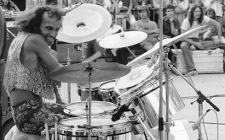
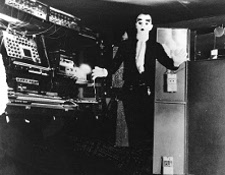
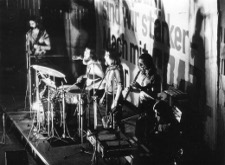
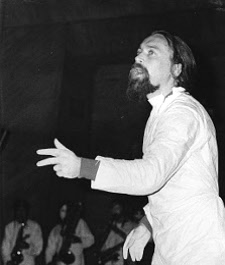
video material [among the video clips are performances by Krautrock heroes
Amon Duul II and Popol Vuh] and liked the idea of incorporating that as well,
thus making it a true multimedia representation.” Additionally, the ROM
contains a massive discography, complete with cross-referencing links and a
search feature, making the disc a key reference work. Easy to navigate, it
sports crisp, uncluttered graphics; a free version of QuickTime is included
for playback of the videos. And as a bonus its includes a separate music
section featuring 40 minutes of ethereal, stimulating Prog by Japanese
composer Hiro Kawahara. Worth noting too: if the project, which consumed over
3 years and numerous beta versions before the final incarnation, is
successful, an updated DVD edition is likely.
Putting things into
perspective, however, Patterson suggests there’s a motivation simpler than
wanting to go hi-tech: to keep spreading the word. As he puts it, “Music is
the essence of life. It enriches beyond imagination. You can see, feel, touch,
smell and fall in love to music.”
What follows is the
transcript of my interview with Patterson, which I initially conducted for Magnet Magazine for our music news item section. (Feel free to check Magnet
out via our website at www.magnetmagazine.com
.) He was so forthcoming with his answers, and included so much excellent info
about the ROM and Eurock in general, that I felt I would be
remiss if the entire thing were not made available to the general public.
-Fred
Mills
FM: When/why did you decide to launch the project? Demand for the back
issues as a prompt, or had you considered doing it all as a website at one
stage, etc?
Archie
Patterson:
The project was initially brainstormed early in 1998, the 25th year of
Eurock's existence (it was started in 1973). I had amassed a virtual history
of groups - features, interviews and reviews - from this particular music
genre. A long time friend Robert Carlberg suggested I digitize it all and do a book. I said,
"Yikes, that'd kill me!" (laugh) He then said, "OK, I'll do
it." We talked about it a bit. I felt books were a bit old-fashioned, and
suggested we take Eurock into the 21st century and do something for the
computer, like a CD-ROM, that would have many more possibilities and be
completely unique (at least for this type of journalism).
FM:
How long did it take to get everything scanned in and/or reformatted? (How many
pages total?) Were there any pitfalls along the way?
AP:
It took Bob perhaps 4-6 months to scan everything in. He sent me diskettes,
and I loaded them onto my computer and arranged the various parts into a
coherent whole along the way. I actually never did a page count, but all the
back issues combined make up a pile that is over a foot high. His incredibly
hard work literally made it a reality.
The
next big question was how to find a programmer who would do the actual ROM
work. A friend of a friend put a notice on a local Net tech news group for me
and I got several enquires. Out of them, one person named David Gillaspey was
very interested, and a nice guy as well. We had a couple meetings, he suggested
a modest fee, and took the project on. My oldest son Aaron (who is now in
college and interns for Microsoft in the summers) had done some initial prep
work for me on the project and sketched out a mock interface upon which David
and myself built the "look" of the project. David did an
extraordinary amount of work without complaint. Without him there would have
been no finished product perhaps. From conception to finish, it took some 3+
years.
FM:
Which of the added features posed the greatest, if any, obstacles? Was the
discography easy enough to compile from your existing materials or was there
additional research involved? How'd you go about getting the rights to include
the videos?
AP:
The Discography was compiled from the original issues, with help from a few
other people, as well as a few reference works listed in the credits section.
Bob did much of that work, with me revising and checking things. Perhaps the
Index was the trickiest as it contained so many links cross-referencing the
simple listings to multiple info. sources. That was the last feature we
decided to add in.
Fortunately
it turned out less daunting than originally imagined programming-wise, or we
(David particularly), might have died at that point. As we went along, many
times we debated what to add in or delete from the final product. There were
many obstacles, mainly trying to get all the components to work together as
introducing a new feature often caused one of the others to need a change in
terms of simple functionality. There were some 70-beta versions with various
people on both MAC and PC testing several of them.
I've
had a lot of video material sent to me over the years, and of course liked the
idea of incorporating that and music as well into the project, thus making it a
true multi-media representation of the genre. The addition of video gave the
project a unique aspect; that has never been done before. I have always tried
to take Eurock into virgin territory. So I contacted the people who had
originally sent me the video, and music, and asked them if I could include it.
They were long-time friends and liked the idea. They said, sure you can use it,
you've always helped promote the music, so let's go ahead and try this new way
of journalism.
The
project really was not looked upon as a commercial venture, but more as a
cultural history of the music, the times, and my life's work. Over the years I
was very lucky to meet some great people who helped me. Those people made my
life very interesting and creative personally, and I helped them a little bit
with their music. It was synchronicity. This whole project really - art work,
design, music, video and everything - was done "with a little help from my
friends" who worked like a sort of extended family to create something
that I could have never been imagined at the outset. It was a very open process
with everyone basically giving of themselves in an unselfish way to make it
happen. I feel honored and blessed that they gave me their time and energy.
FM:
What was your original intent or motivation with Eurock, how has that extended
into the present with your mail order operation, and do you foresee expanding
things (such as updating stuff that's on the CD-ROM over time or going to DVD)
or moving in other directions in the future?
AP:
My original idea was simply to share the new, amazing music I had discovered
with some new "friends." Inspired by Greg Shaw's great rock and roll
fanzine, Who Put the BOMP, a friend, Scott Fischer and I, started
writing and all else simply came to pass. One friend had access to a Xerox (at
the office of the law firm where he was a gopher). Later another worked with
an offset printing press (at the local public schools building). All the work
was done "underground” at night (laugh). It was a wild and wonderful
set of happenstance occurrences that could almost only have come about during
those times.
As
a result of the first couple issues of Eurock I was asked to run two of the
original, pioneering, import music companies of the golden era of imports
during the 1970's (Intergalactic Trading Company & Paradox Music, a part of
Greenworld Imports). At the outset of the 1980's I decided to do Eurock on my
own and from there on things just kept growing. In a sense, the title The Golden
Age (suggested by my 12 year old son Sky) was intended to reflect the
particular spirit and nature of the music that was being produced during that
time.
As
for the future, there are now more interviews being done with new musicians,
old music friends and fave groups from the past that keeps the spirit alive
with musically today. They are incorporated into www.eurock.com
periodically.
The
next big project will be a book compiling the main articles from the CD-ROM and
new ones that are now being done. Tentatively titled EUROCK - European Rock &
the Second Culture, it will reflect a bit different
socio-political perspective than the CD-ROM, but nonetheless continue the
concept that always underscored my work with Eurock. After the CD-ROM came out
I got many people asking for a book to curl up with and read in bed (hmmm, what
can I say about that one, I might have a few other thoughts myself... laugh).
There could be DVD projects as well
as that has been talked about and would be another step forward for Eurock.
FM:
Prog-rock, Krautrock, Eurock - are labels useful?
AP:
Labels can be good, but also meaningless. The Germans hate the name
"Krautrock," considering it a derogatory word invented by English
journalists. I read the very first articles on German space rock in the UK
press however, and for the most part the writers were raving about how great the music was. So I
think it’s a sort of culture clash situation. As for Eurock, of course
that's a great name as I made it up (big laugh).
I
do think labels can define a sound and style, but are often used to lump a lot
of junk into a marketing category. Perhaps that's my (and others) big objection
to the term Krautrock. Like everything else in life, both good and bad can flow
from the same thing. What matters is whether you walk in a straight line and
never speak with a forked tongue (laughing again).
FM:
Record collectors: hopeless geeks, or passionate/enlightened freaks?
AP:
Music is the essence of life and I think people who feel passionately about it
understand that, which is great. Again, however, that can cut both ways (can't
everything)? It
can also inspire less than rational attitudes, and sometimes make people lose
sight of the real value of music to their lives. I personally have been
labeled as many things, and only occasionally do they seem to fit in my
estimation.
I
do know that for myself music became a central part of my life very early on
(10 years old in fact) and to this day enriches it beyond imagination. You can
see, feel, touch, smell and fall in love to music. The great poets and
musicians of the ages echo that, and from my own personal experience I can say
it is definitely true.
|